
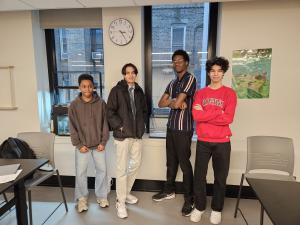
- Program:
- Urban Barcode Project
- Year:
- 2025-26
- Research Topic:
- Biodiversity & trade
- Taxonomic Group Studied:
- Fungi
Project:
An Investigation of Microhabitats: Fungal Diversity
- Students:
- Cameron Ruszkowski, Ikram Agbagni, Leonardo Gregori-del Rosario, Thierno Bah
- School:
- The Browning School, Manhattan
- Mentors:
- Akira Wong
Abstract:
Fungal diversity is a critical determinant of ecosystem health, driving essential processes such as soil fertility, plant productivity, and resilience against environmental stressors. This investigation explores the relationship between distinct microhabitat characteristics—specifically moisture levels, canopy cover, and vegetation density—and fungal species diversity within the urban environment of Central Park. We hypothesize that microhabitats exhibiting high moisture retention and dense canopy cover will support greater fungal diversity compared to exposed, manicured lawns, despite the uniform presence of urban pollutants. To test this, four distinct microhabitats (ranging from 50 m² to 100 m²) will be surveyed to account for variations in shade, elevation, and proximity to water. Fungal specimens will be collected and subsequently identified using DNA barcoding, specifically targeting the amplification of the internal transcribed spacer (ITS) region via polymerase chain reac
