- Program:
- Barcode Long Island
- Year:
- 2025-26
- Research Topic:
- Wildlife
- Taxonomic Group Studied:
- Animals: Invertebrate
Project:
The Impact of Worms on Soil Ecology in a Long Island Suburb
- Students:
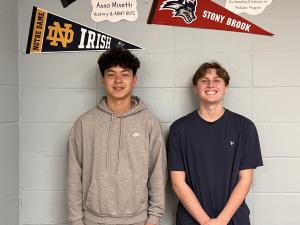
- Andrew Roberts, Kenzo Wentz
- School:
- Shoreham-Wading River High School, Suffolk
- Mentors:
- Dana Schaefer
Abstract:
Worms are relatively simple, soft bodied invertebrates. They often play a fundamental role in ecosystems such as the underground soil environment as they aerate the ground and break down organic matter to provide nutrients. The study of worms by focusing on their environmental impact allows for the understanding of the mechanisms by which worms cycle nutrients and contribute to overall ecosystem health. Analyzing their contributions helps to understand the complex interactions of soil and worms as well as the decomposition process, in which worms play an integral role. The worms will be studied by sequencing their DNA by utilizing DNA barcoding, as well as by using taxonomic identification techniques and procedures to further learn their behavior and genetics. It is anticipated that in the presence of worms, the soil samples will have higher nutrient availability due to the necessary role they play.
Poster: